Life of Father of the Nation Mahatma Gandhi
Mahatma Gandhi, a name that reflects the ideals of truth, non-violence, and selfless service, holds a special place in the history of India and the world. Born on October 2, 1869, in Porbandar, Gujarat, Gandhi’s life journey was marked by his unwavering commitment to principles that not only shaped India’s struggle for independence but also inspired movements and leaders across the world. This article highlights the extraordinary life of the Father of the Nation, Mahatma Gandhi.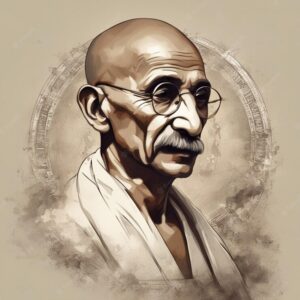
Childhood and Parenting
Born on October 2, 1869, in Porbandar, Gujarat, Mohandas Karamchand Gandhi, affectionately known as Mahatma Gandhi, grew up in an environment deeply imbued with values. His parents instilled in him the qualities of honesty, simplicity and sympathy. Gandhi’s childhood established the groundwork for his later way of thinking of life and his relentless devotion to the government assistance of humankind.
Early years and influence
Gandhi’s formative years were characterized by a keen sense of curiosity and an eagerness to learn. He was from a simple background and his upbringing was infused with the values of simplicity and integrity. His exposure to literature and the moral guidance of his family played a significant role in shaping his character.
Education and Beginnings
After completing his early education in India, Gandhiji went to London to study law. This contact with the Western world expanded his horizons and exposed him to the ideas of freedom, democracy, and civil rights. It was during this time that he laid the foundation for his philosophy of non-violence, known as “Satyagraha”, which means the search for truth.
Satyagraha: The Power of Truth
The concept of “satyagraha”, which translates to “true force” or “spiritual force”, became a cornerstone of Gandhi’s philosophy. He believed that individuals could resist oppression through non-violent means, awakening the conscience of the oppressor and forcing them to change. This principle guided his actions and strategies throughout his life, shaping his leadership in India’s freedom struggle.
Champaran and Kheda Movement
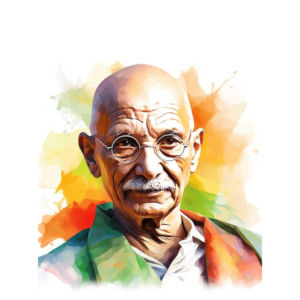
Before his return to India, Gandhiji’s kind heart and dedication to justice was evident from his participation in the Champaran and Kheda movements. In Champaran, he advocated the interests of indigo farmers, protesting against the exploitative practices of the British landlords. In Kheda, he rallied against high land taxes during a severe famine and demonstrated his unwavering commitment to the welfare of Dalits.
South Africa: Shaping a Leader
A turning point in Gandhiji’s life came when he went to South Africa to practice law. There he saw firsthand the injustice done to the Indian community due to racial discrimination. Gandhiji was deeply affected by these experiences, which inspired him to dedicate himself to fighting against oppression and injustice. He launched his first civil rights movement in South Africa, advocating equal rights and justice for all.
Conversion
The turning point in Gandhiji’s life was when he moved to South Africa, where he faced racial discrimination and injustice. He became an advocate for the rights of the Indian community there, adopting nonviolent resistance to fight against repressive laws. His leadership skills and his commitment to justice emerged during this period.
Return to India and leadership in the Freedom Movement
Upon his return to India, Gandhi’s heart ached for the struggle of his motherland under British colonial rule. He began mobilizing the masses against injustice, poverty, and the salt tax. His philosophy of non-violence gained momentum and he led various movements, including the Non-Cooperation Movement and the Quit India Movement, which sought to challenge British authority peacefully but firmly.
Non-Cooperation Movement and Salt March
One of the most iconic events in Gandhiji’s life was the Salt March. In 1930, he led a group on a 240-mile march across the Arabian Sea to protest the British salt monopoly. This act of civil disobedience caught the world’s attention and demonstrated Gandhi’s commitment to breaking unjust laws through nonviolent means. Gandhi’s role in India’s freedom struggle gained prominence during the Non-Cooperation Movement. He called for a peaceful boycott of British institutions, encouraging Indians to reclaim their self-respect and dignity. This movement, along with the historic Salt March, demonstrated Gandhi’s ability to organize masses in a nonviolent struggle against oppressive colonial rule.
Legacy and Global Impact
Gandhiji’s non-violence philosophy left an indelible mark not only on India’s freedom struggle but also on the world stage. Leaders such as Martin Luther King Jr. and Nelson Mandela drew inspiration from his teachings to lead their movements for civil rights and justice. Gandhi’s life is a testament to the power of peaceful resistance and the potential for change through unwavering determination.
Conclusion
In the tapestry of history, the life of Mahatma Gandhi shines forth as a beacon of hope, compassion, and unwavering commitment to justice. His journey from a young boy in Porbandar to a global symbol of nonviolence reminds us that even in the face of adversity, one person’s determination can ignite a revolution. As we remember Gandhi’s legacy, let us strive to adopt the principles of truth, nonviolence, and service in our lives, contributing to a more just and harmonious world.
Thank You For Reading
To Know More, Please Click on the Below Link
https://smartkid.searchinfography.com/
 To Buy Click Here